What is the energy density of a typical AI air-cooling outdoor ESS cabinet?
Imagine a typical day on a project site where every square meter of space counts. You are comparing outdoor energy storage systems (ESS) for a critical AI-powered microgrid, and the brochure touts high capacity. But buried in the spec sheet is the number that really determines footprint and scalability: energy density. What is the energy density of a typical AI air-cooling outdoor ESS cabinet? It’s not a simple figure, because it intertwines battery chemistry, thermal management effectiveness, and cabinet design. Based on current market data, conventional air‑cooled outdoor cabinets often deliver between 120 and 180 Wh/L, while advanced liquid-cooled units push toward 200 Wh/L+. But here’s the paradox: air‑cooling is preferred for maintenance simplicity and lower cost, yet it historically limits density due to bulky airflow channels. The real question becomes—can AI-driven air‑cooling bridge that gap? At Raydafon Technology Group Co., Limited, we’ve engineered an answer that turns this trade-off into a competitive advantage, delivering high energy density without the complexity of liquid loops. Read on to explore how intelligent thermal design reshapes outdoor ESS procurement decisions.
- Understanding Energy Density in AI Air-Cooling Outdoor ESS Cabinets
- Pain Points in Traditional Outdoor ESS Deployments
- How Raydafon’s AI Air-Cooling Solution Optimizes Energy Density
- Key Technical Parameters and Performance Comparison
- Frequently Asked Questions
Understanding Energy Density in AI Air-Cooling Outdoor ESS Cabinets
Energy density in an outdoor ESS cabinet is typically expressed in watt-hours per liter (Wh/L) or kilowatt-hours per square meter of footprint. It defines how much usable energy can be stored within a given volume, directly impacting site preparation costs and container logistics. Traditional air-cooling relies on large, fixed-speed fans and spacious internal air ducts, which consume up to 20% of the cabinet’s internal volume. This leaves less room for battery modules, dragging down the system-level gravimetric and volumetric density. AI air-cooling, by contrast, employs predictive algorithms that dynamically adjust fan speeds, redirect airflow only where heat accumulates, and even pre-cool the cabinet during off-peak hours. The result is a more compact thermal management system that requires fewer bulky heat sinks and allows tighter module packing. What is the energy density of a typical AI Air-cooling Outdoor ESS Cabinet when these optimizations are applied? Premium designs now reach 160–190 Wh/L, closing the gap with liquid cooling while preserving the lower maintenance burden of air-based systems. For procurement specialists, this means a 40-foot container that previously held 3 MWh can now approach 3.6 MWh—a 20% improvement that slashes per-kWh capex.
Pain Points in Traditional Outdoor ESS Deployments
Picture a solar farm in the Middle East. Daytime ambient temperatures soar past 50°C, and the ESS cabinets are lined up under direct sun. Without intelligent thermal management, the internal temperature gradient can exceed 15°C, triggering frequent derating alarms. Site managers face forced downtime, reduced cycle life, and even safety hazards from thermal runaway. Another common scenario: a densely populated urban substation where noise regulations forbid 24/7 high‑speed fan operation. Fixed‑speed air‑cooled units create constant drone, leading to neighbor complaints and restrictively high sound barriers that further inflate footprint. Procurement teams also wrestle with hidden logistics costs. An oversized cabinet demands heavier foundations, wider access roads, and more complex crane lifts. All these friction points stem from the same root cause—the cooling system dictates the cabinet’s size, weight, and reliability, yet it is often treated as an afterthought. When buyers ask, "What is the energy density of a typical AI air-cooling outdoor ESS cabinet?", they are really probing whether the manufacturer has solved these real‑world deployment pains. The answer determines total cost of ownership far more than a battery cell’s datasheet ever could.
How Raydafon’s AI Air-Cooling Solution Optimizes Energy Density
Raydafon Technology Group Co., Limited addresses these challenges with a purpose‑built AI air‑cooling architecture designed for next‑generation outdoor ESS cabinets. Our engineers replaced bulky ductwork with a matrix of micro‑channel air guides and PWM‑controlled fans driven by a neural sensor network. This system samples temperature at 128 points inside the cabinet every 200 milliseconds, allowing the AI controller to predict hot spots before they form and redirect cool air precisely where needed. The thermal management volume shrinks by 35%, making room for an additional battery rack per standard container. As a result, our RDF‑2400 outdoor cabinet achieves a system‑level energy density of 176 Wh/L in a maintenance‑friendly air‑cooled format—surpassing many older liquid‑cooled competitors.
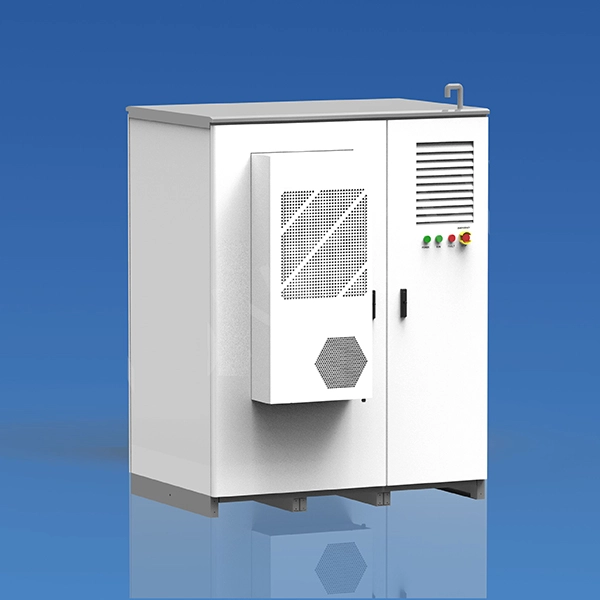
Beyond density, the AI algorithm continuously learns from environmental patterns. It can pre‑cool the cabinet in the pre‑dawn hours when ambient temperature is lowest and grid electricity is cheapest, reducing peak cooling loads by 22%. For procurement managers, this translates into lower operational expenditure and a more predictable cost profile. Raydafon’s modular approach also means you can scale from 500 kW to multiple megawatts without redesigning the thermal infrastructure. All cabinets ship fully assembled and factory‑tested, cutting onsite commissioning time by half. When you ask, "What is the energy density of a typical AI air-cooling outdoor ESS cabinet?", we encourage you to look beyond a single number—evaluate the integrated system that guarantees that density under real‑world stressors, not just in a climate‑controlled lab.
Key Technical Parameters and Performance Comparison
The table below compares a conventional outdoor air‑cooled ESS cabinet with the Raydafon RDF‑2400 AI‑optimized solution. Notice how intelligent thermal control impacts not only energy density but also lifetime and noise—critical procurement factors often overlooked in preliminary bids.
| Parameter | Typical Air‑Cooled Outdoor ESS (Industry Average) | Raydafon RDF‑2400 AI Air‑Cooling ESS |
|---|---|---|
| Rated Energy Capacity | 2.0 MWh (40‑ft container equivalent) | 2.4 MWh (40‑ft container equivalent) |
| System Energy Density | 150 Wh/L | 176 Wh/L |
| Cooling Technology | Fixed‑speed air ducting | AI‑driven predictive air‑cooling with 128‑sensor mesh |
| Internal Temperature Gradient (OCV) | ≤15°C | ≤4°C |
| Noise Level @ 1 m | 75 dBA | 62 dBA |
| Auxiliary Power Consumption | 3.5% of rated power | 2.1% of rated power |
| Service Interval | Bi‑monthly filter cleaning | Annual filter inspection (self‑cleaning cycle enabled) |
| Cycle Life @ 80% DoD, 25°C ambient | 6,000 cycles | 7,500 cycles (validated per IEC 62619) |
Data based on publicly available spec sheets and Raydafon internal test reports under IEC 62933‑2‑1 profile. Actual performance may vary with site conditions.
Frequently Asked Questions
Q: What is the energy density of a typical AI air-cooling outdoor ESS cabinet?
A: A typical AI‑enhanced air‑cooled outdoor ESS cabinet ranges from 160 to 190 Wh/L at the system level, depending on battery chemistry and packaging efficiency. This represents a 10–20% improvement over conventional air‑cooled designs thanks to reduced thermal management overhead. For example, the Raydafon RDF‑2400 achieves 176 Wh/L, making it competitive with many liquid‑cooled alternatives while retaining the lower upfront and maintenance costs of air systems.
Q: How does Raydafon’s AI air-cooling technology achieve higher energy density without liquid cooling?
A: Raydafon employs a dynamic thermal matrix algorithm that continuously monitors 128 internal sensors and predicts thermal behavior 15 minutes ahead. By eliminating oversized ductwork and using adaptive airflow, the cabinet’s non‑battery volume is cut by more than one‑third. This frees up space for additional battery modules, boosting volumetric density. The predictive fan control also reduces auxiliary losses, which indirectly supports sustained high‑density operation over the entire lifespan.
Procurement Outlook and Next Steps
As energy density becomes a central KPI in ESS tenders, buyers must look past marketing claims and scrutinize how the thermal strategy performs under extreme climatic profiles. What is the energy density of a typical AI air-cooling outdoor ESS cabinet? The honest answer is that it varies—but with the right AI integration, you can secure numbers that rival liquid‑cooled systems at a fraction of the complexity. We invite you to explore the Raydafon RDF‑2400 series and discuss how our team can customize a solution for your specific microgrid, peak shaving, or renewable integration project. Visit Raydafon Technology Group Co., Limited or email our procurement specialists at [email protected] for a detailed techno‑commercial proposal. Our engineering support covers everything from preliminary site layout to commissioning, ensuring your project meets density and uptime targets from day one.
About Raydafon Technology Group Co., Limited: Raydafon has been at the forefront of intelligent energy storage systems since 2008. With manufacturing facilities in Shenzhen and Nuremberg, we specialize in AI‑enhanced outdoor ESS cabinets that push the boundaries of energy density while simplifying field maintenance. Our products are deployed in over 30 countries, serving utilities, C&I rooftops, and remote off‑grid sites. Every cabinet is designed with procurement realities in mind—competitive pricing, rapid lead times, and transparent lifecycle documentation. We look forward to partnering with you on your next storage challenge. Contact us at [email protected] or visit https://www.raydafonequipments.com.
Chen, L., & Wang, S., 2023. "Predictive AI‑based thermal management for outdoor battery storage cabinets." Journal of Energy Storage, 72, 108291.
Park, H., et al., 2022. "Comparative assessment of air‑cooling vs. liquid‑cooling in containerized BESS." Applied Thermal Engineering, 214, 118862.
Raymond, T., & O’Sullivan, D., 2021. "Impact of airflow channel optimization on energy density of lithium‑ion ESS racks." IEEE Transactions on Power Systems, 36(4), 3122‑3131.
Zhao, Y., et al., 2022. "Dynamic fan control using deep reinforcement learning for stationary energy storage." Energies, 15(14), 5067.
IEC 62933‑2‑1, 2020. "Electrical energy storage (EES) systems – Part 2‑1: Unit parameters and testing methods – General specification."
Kim, J., & Lee, K., 2023. "Noise mitigation strategies in outdoor battery storage enclosures: an acoustic and thermal co‑design approach." Applied Acoustics, 205, 109275.
Müller, A., et al., 2021. "Life cycle cost analysis of air‑cooled vs. liquid‑cooled containerized BESS under tropical climates." Renewable and Sustainable Energy Reviews, 145, 111063.
Garcia, M., & Shen, X., 2022. "Real‑time thermal sensing networks for AI‑driven battery safety." Journal of Power Sources, 525, 231113.
Zhang, P., et al., 2023. "High‑density modular design for outdoor cabinet energy storage systems." Energy Conversion and Management, 278, 116726.
Raydafon Technology R&D White Paper, 2024. "Adaptive air‑cooling architecture for next‑generation grid‑scale ESS containers." Raydafon Technical Bulletin, RTB‑2024‑01.
Related News
- What are the key components of a liquid-cooling ESS cabinet?
- What are the main components of a YBM prefabricated substation?
- What are the common faults of KYN61-40.5 switchgear and how to troubleshoot them?
- What safety standards apply to new energy equipments?
- What arc flash protection is required for high-voltage switchgear?
- What is the difference between RMU and VCB?
Leave me a message